
There is a hunger in the church today that often goes unmet, a genuine desire among church members to be trained in biblical exposition. Not just how to listen to sermons, but how to handle the Word themselves. How to read it carefully, interpret it faithfully, and communicate it clearly in whatever context God has placed them.
Two Kinds of Ministry
In 1 Peter 4, the apostle identifies two broad categories of ministry in the body of Christ, speaking and serving.
10 As each has received a gift, use it to serve one another, as good stewards of God’s varied grace: 11 whoever speaks, as one who speaks oracles of God; whoever serves, as one who serves by the strength that God supplies—in order that in everything God may be glorified through Jesus Christ. To him belong glory and dominion forever and ever. Amen. (ESV)
Both speaking and serving matter, but from my (albeit limited) perspective, much of our discipleship infrastructure in local churches tends to emphasize the how-to-serve side of things more than the how-to-speak side. We train people to set up chairs, run sound, and serve in the nursery, all of which are really important, but are we also training them to open the Bible and teach it faithfully and effectively?
Ephesians 4 reminds us that every believer is called to speak the truth in love. Not just those specially gifted to do so. Speaking is not just the role of the pastor-teacher. And notice it’s speaking the truth (biblical content rightly understood) in love (effective manner and delivery of that content).
Why Hermeneutics Matters for Everyone
One of the questions I keep coming back to in my own mind is this: Why isn’t hermeneutics (theories and principles for interpreting the Bible) a more prominent part of local church training?
The ability to rightly read Scripture is not just for a select group of seminary-trained professionals. The study of hermeneutics equips every believer to read the Bible for themselves with confidence and discernment instead of being completely dependent on someone else’s interpretation. It enables them to evaluate what they’re reading and hearing in books, podcasts, and sermons from the pulpit. It helps them engage more meaningfully in those sermons as active, thoughtful, Berean-type listeners. And it gives them a genuine appreciation for the craft of exposition, an understanding of what it actually takes to move from a text to a faithful, clear, applicationally-sound communication of it.
I think there’s also a parallel need for church members to be equipped in basic rhetorical skills. It’s not enough to know how to interpret the Bible if you don’t know how to share it. Whether someone is leading a small group, teaching Sunday school, sharing a devotional at a men’s breakfast, or doing family discipleship around the dinner table, these are all Word ministries, and they all benefit from learning not just what to say (getting it right) but how to say it (getting it across).
Cutting It Straight
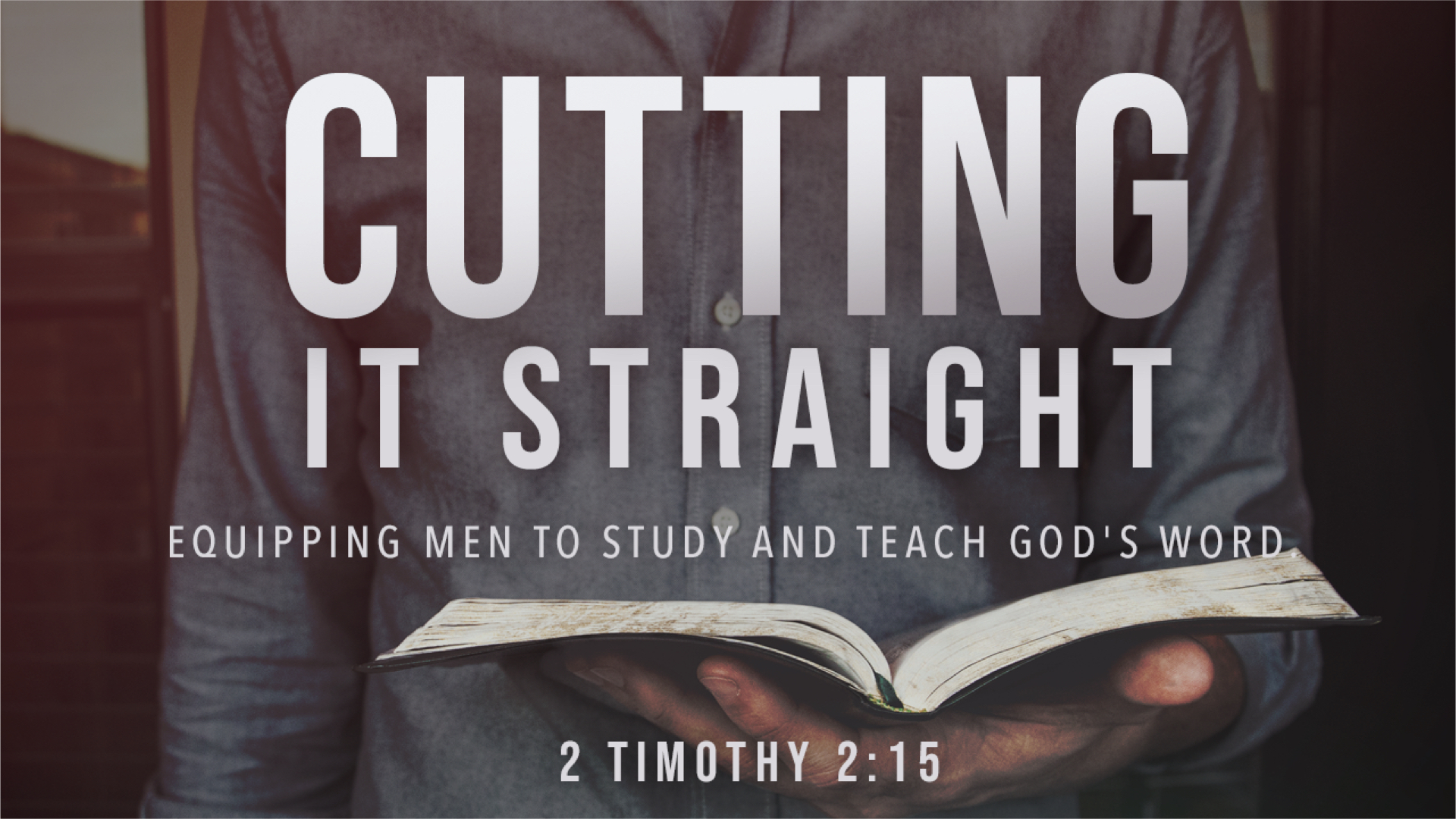
This burden of mine led to a conference called Cutting It Straight, a name drawn from Paul’s charge to Timothy in 2 Timothy 2:15 to rightly handle the word of truth. It’s a weekend intensive designed to train men in the skills of biblical interpretation and communication, working through a specific book of the Bible and equipping participants to understand the text and teach it in whatever context God they’re in.
The seed for this conference was planted during my twenty-plus years of serving as the coordinator for the annual High School Preaching & Teaching Conference at Bob Jones University. As part of that annual event, we offered young people the opportunity to learn how to interpret and teach God’s Word. What had once been a sermon contest (not a great idea) eventually became a workshop-style track for teens. It was a significant shift, and the students who participated (and their parents and their pastors) genuinely valued the emphasis on equipping them not just evaluating them.
But the format had some logistical problems. Students who were also involved in the choral and fine arts competitions frequently had to miss sessions due to scheduling conflicts. It felt disjointed, and after some reflection, we concluded that the preaching and teaching track would work much better as a standalone event instead of something tacked onto a larger festival.
When I reached out to churches that normally sent students to the high school event, Calvary Baptist Church in Westminster, MD expressed an interest in hosting something at their church dedicated not just for teenagers but also for adults. Their instinct proved right. The turnout the first year well exceeded our expectations, and the response from participants told us that this was something we needed to do again.
The Conference at Calvary
So for the past two years, I’ve had the privilege of going up to Calvary to lead the Cutting It Straight conference. The event drew men from at least nine churches last past March, with over 70 attendees gathering Friday evening and spending most of Saturday digging into one particular book of the Bible.
The model is intentional. Each year, we focus on a different genre. The first year we focused on discourse-type texts. We discussed interpreting and teaching from the New Testament epistles, using 1 Peter as our anchor book. This March we turned our attention to narrative texts. We focused specifically on Old Testament narrative, devoting our time to the four chapters of Ruth (this may be the first time in the history of the church that a men’s conference has studied the book of Ruth together!).
The philosophy and principles stay constant. What changes is the text-type or book we focus on. That means someone can come back year after year and be challenged to apply the same principles to new material, but all rooted in the same philosophical foundation. It also means the conference can grow a stable core of returning participants while remaining accessible to first-timers.
For years I’ve benefited tremendously from attending Charles Simeon Trust workshops here in Greenville. Cutting It Straight definitely draws some inspiration from those CST workshops, though it’s distinct in important ways. The Simeon Trust model is oriented toward pastors and those aspiring to pastoral ministry, with participants completing worksheets in advance and presenting their work in small groups. Cutting It Straight is for any church member, young or old, and it follows more of a seminar teaching-and-discussion format. I teach a segment, and then table groups, each led by a facilitator, work through the material together and apply the concepts in real time. There’s no preliminary homework, so the bar of entry is much lower. We also send participants home with books and resources to support their ongoing work as students and teachers of God’s Word.
How the Host Church Has Benefited
One of the most encouraging aspects of this kind of training is what it surfaces in a local church as a result. There is transformative value to this kind of investment in equipping the saint for the work of Word-based ministry.
For a church that is actively sending members into church planting and missions, the need to develop the next generation of teachers is critical. When leaders go out, gaps are left behind, and a church that has been intentionally training men to handle the Word is far better positioned to remain healthy through those transitions.
The seminar also proved to be a catalyst for identifying emerging gifts. One of the teens who wasn’t on anyone’s radar for being interested in this type of training attended the conference and ever since has been reading everything his pastors have given him. His hunger for the Word and his desire for ministry were unknown until that weekend. Who knows. Training like this may have the effect of revealing a desire and hunger that is already present in your church; it’s just waiting to be drawn out.
The gathering of men from nine different churches also created something special. Pastors who brought men they were mentoring found themselves in the room alongside other pastors doing the same thing. That shared commitment to raising up the next generation of teachers, with mentor and apprentice learning side by side, generates a kind of synergy that is difficult to manufacture any other way.
A Vision Worth Pursuing
The local church should be a place where every believer has the opportunity to be trained to handle the Word of God. Not just professionally credentialed preachers, but parents, small group leaders, and Sunday school teachers – anyone who wants to grow in their ability to communicate God’s Word to others in a wide array of contexts.
I don’t think that training in biblical interpretation and exposition should be reserved for the academy. They are tools for discipleship, and the church that invests in them invests in the long-term health and stability of its people, forming up men and women who won’t be easily blown about by every wind of doctrine, and who are equipped to speak truth in love wherever God has placed them.
This post grew out of a recent conversation I had with Ken Casillas on the Theologically Speaking podcast. The interview will be released in the near future. But if your church is interested in hosting a Cutting It Straight seminar, I would love to hear from you. Whether you’re a pastor looking to invest in your people, a church seeking to develop the next generation of teachers, or a ministry leader curious about what this kind of training might look like in your context, please reach out. Nothing would encourage me more than seeing this kind of equipping spread to more churches.